KLOW peptide dosage, units and frequency
The label adds up neatly. The research quantities come from different species, routes and experimental questions.
KLOW 80 peptide protocol searches
There is no validated human KLOW peptide dose, dosing protocol or frequency. “KLOW 80 peptide protocol” refers to a search for instructions that the published blend evidence cannot supply. The familiar 80 mg figure describes the contents of a usual research vial.
Such tidy arithmetic leaves me suspicious. A fixed mixture makes it easy to divide a total, while the unanswered questions concern exposure, compatibility and safety. Arithmetic cannot supply those measurements.
The usual ingredient weights
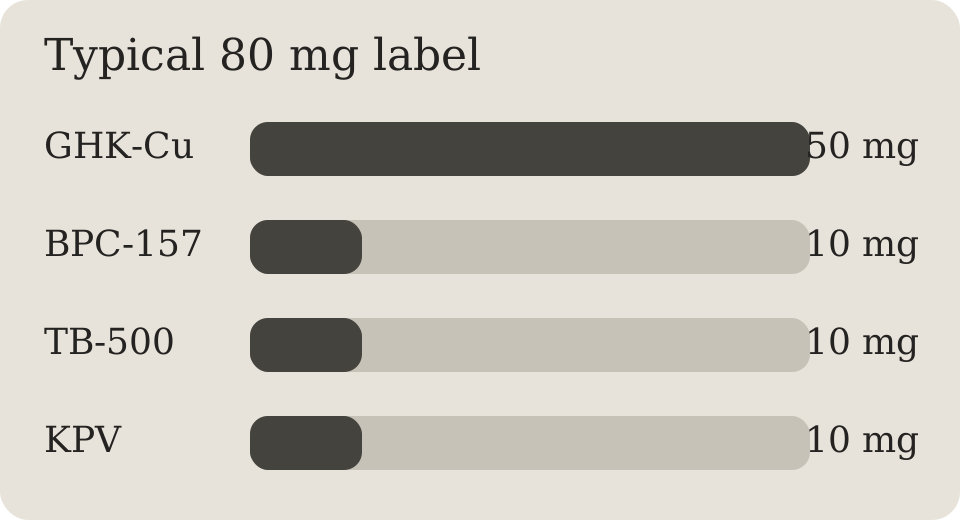
The common label lists GHK-Cu 50 mg, BPC-157 10 mg, TB-500 10 mg and KPV 10 mg. That ratio comes from research-product labeling. No clinical trial has validated it as a human KLOW dosage.
The 50 mg entry is the copper-peptide complex: its weight includes the peptide as well as the copper. GHK-Cu accounts for about 62.5% of the 80 mg total. The ingredient page explains why a large mass share says little about the contribution to an outcome.
Quantities used in separate experiments
The rat tendon study tested BPC-157 at 10 micrograms, 10 nanograms or 10 picograms per rat. The KPV study used 10 nanomolar in cell culture and 100 micromolar in mouse drinking water. Those last units describe concentration in a liquid.
Human GHK-Cu work summarized in the skin review involved topical preparations. The BPC-157 pilot involved intravenous administration up to 20 mg in two healthy adults. Each route put a different ingredient into a different experimental setting.
I prefer each experimental quantity with its original unit still attached. Converting every quantity into a daily amount for the blend would erase the distinctions that made the study interpretable.
KLOW peptide dosage and frequency
No published human blend study has established KLOW peptide dosage and frequency. Component research raises a further question about how long the ingredients remain available: the small tripeptides and BPC-157 have different reported clearance behavior, and TB-500 differs from native thymosin beta-4.
That is a concern drawn from separate component work. The exposure profile of the co-formulated mixture has not been measured. There is no tested KLOW calendar to extract from it.
Mixture stability
The research material is freeze-dried. Laboratory handling descriptions involve a bacteriostatic diluent containing benzyl alcohol, a preservative, and refrigeration after reconstitution. Those descriptions establish no tested stability period for the mixture.
Copper in GHK-Cu can participate in redox chemistry, reactions involving electron transfer. That creates a theoretical compatibility question when the other peptides share the same solution. The stability and chemical behavior of this four-part mixture have not been formally characterized.
A storage claim or a mixing instruction would not settle that chemistry. Safety concerns and the KLOW stack provide the surrounding context.